Based in Barcelona

Mose Hayward
Train Nerd
I’ve ridden Iryo trains a number of times and am growing to love this operator’s high-speed service for zipping between cities in Spain and Catalonia. For me, each experience has been seamless, friendly, trouble-free, and on time.
That said, Iryo has good competitors, and I’m happy to take them too (see our reviews of Ouigo, Ave, and Avlo services). We’ve also done a comparison of all high speed train services in Spain. In this article I’ll be focusing on my experiences and those that other have reported with Iryo specifically, so that you can decide if it’s for you.
But in a nutshell: All of the high-speed services in Spain are pretty comfortable and relatively reliable. I tend to take whichever is most convenient and cheap for a specific trip—see how I price compare, next.
UPDATE OCTOBER 29, 2026: Since the October 28 crash near Urda (Toledo), high-speed trains between Madrid and Andalusia (Córdoba, Seville, Málaga and beyond) have been suspended, with no reopening date yet. Renfe’s Barcelona and Valencia trains to Andalusia via Madrid are stopped too. Renfe has paused ticket sales on the route until December 13, so if you can’t find these trains on Renfe’s site or on Trainline, that’s why; it isn’t a website glitch, and the line may reopen sooner. Iryo has canceled its Andalusia trains with no restart date, and Ouigo has canceled its own until at least November 2. Renfe plans alternative transport from October 30, and the operators are offering free changes and cancellations. The closure doesn’t affect other lines, such as Madrid–Barcelona. For the latest, your refund rights and how the risks compare, see Are Spanish Trains Safe After the Toledo Crash?
Compare All Train Operators in Spain for the Cheapest Tickets
Iryo can sometimes offer the cheapest and best way to get from point A to B—and when it does, we take it. But just as often, we find cheaper high-speed train tickets on Ouigo, Avlo, or sometimes even Ave.
To compare Iryo pricing and all other high-speed train options at once (as well as buses and standard trains), we just plug our search into Trainline. The search interface finds smarter routes (including combinations of Iryo with standard trains to get to places Iryo doesn’t serve) and has fewer bugs and errors than the Renfe or other operator websites, while showing the same per-ticket prices for each one.
Trainline is like a Google Flights or Kayak, but for trains. (Omio is another train comparison option but it doesn’t work as well for Spain as it has incomplete coverage.)

Iryo Advantages and Disadvantages
Iryo offers fast, cheap train rides around Spain and Catalonia. But so do the other high-speed operators. Here is what to keep in mind about Iryo’s offer that sets it apart—the good and the bad.
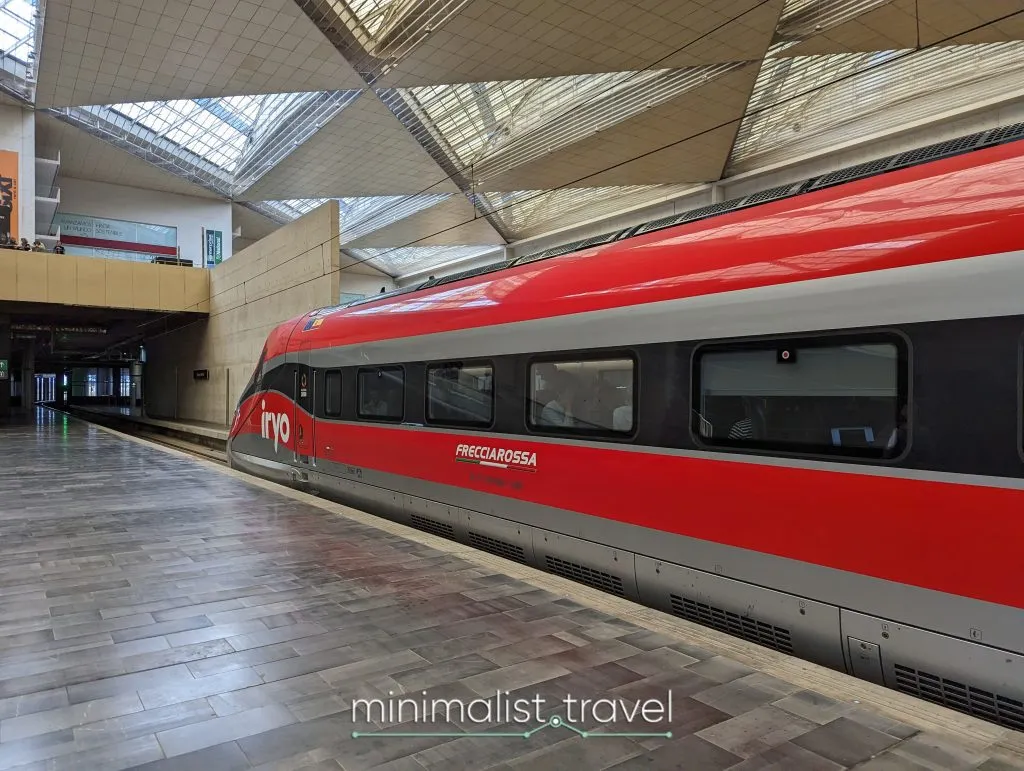
The Advantages of Travelling with Iryo
- Iryo offers cheap tickets—often but not always cheaper than the comparable national operator Renfe’s Ave high-speed service.
- Iryo has more classes of service and better amenities and extras than the competing budget high-speed services Ouigo and Avlo. This includes a bar car, in-seat food service, and much more permissive baggage limits (details below on all of these).
- All Iryo trains are high-speed, meaning that you’ll get to your destination hours quicker than if you traveled by regular-speed trains.
- Children aged 0 to 3 years old travel for free.
- Wi-Fi is included as part of all ticket types (though it’s slow and cuts out, as on all Europe high-speed trains).
Disadvantages of Travelling with Iryo
- Iryo can sometimes cost a bit more than the other budget train options, though not by a lot; check for your trip as discussed in the booking comparison note above.
- Iryo doesn’t offer discounts for those aged 4 to 18, unlike its budget competitors in Spain. (When searching for tickets on Trainline you can enter the ages of any children and find the overall cheapest budget train route for your group—for families with kids Iryo is unlikely to come out cheapest in these searches.)
- While its service covers more of Spain than Ouigo’s or Avlo’s, it’s nevertheless true that Iryo only serves certain major cities. For other destinations, you may need Renfe trains. Fortunately, if you’re headed to or from other corners of Spain (or into or out of Catalonia, France, Portugal, etc.), Trainline automatically calculates your options for combining Iryo, other budget train operators, the national train operator Renfe, and bus services.
The Experience on Iryo Trains

The Reliability of Iryo Trains

Iryo trains generally run on time and can be considered a relatively safe bet for getting to where you need to go. According to press reporting on recent studies (in Spanish), only 5% of Iryo trains suffer delays and when they happen the average length of the delay is 28 minutes.
That compares to 5% for Ouigo and 7% for Renfe. Ouigo’s average delay is 39 minutes and Renfe’s is 21 minutes.
According to the same reporting, 63% of the delays of high-speed trains that do happen in Spain are due to the train operators themselves (Ouigo, Iryo, or Renfe); the rest of the delays are caused by issues with the rail networks themselves.
Customer Service on Iryo

Every time I’ve taken Iryo, the service on board the trains has been impeccable: friendly and efficient. The staff seems to more or less enjoy what they’re doing. This is in contrast to the service on Ouigo or standard SNCF services in France, which I’ve seen become hostile to the point of hilarious, and Renfe in Spain, which can be gruff and unintelligible.
Although, as our resident train ticket inspector writes, as long as you treat any European train staff with a fair amount of respect and follow the rules, they’re likely to bend over backwards to try to help you. Unless they happen to be in a bad mood or something.
Iryo booking is possible on Trainline (to compare with other operators) or directly from Iryo itself on its website and stores in train stations. Changes are possible on Trainline or Iryo websites, depending on where you got your ticket. Iryo customer service can be reached on +34 910 150 000 or [email protected].
Luggage on Iryo

Iryo’s luggage limits depend on your fare class.
- In the standard class, Inicial, you are limited to one piece of “cabin baggage” measuring 55 x 35 x 25 cm. (21.7 x 13.8 x 9.8 in.) and one piece of “hand luggage” (like a small backpack or airline underseat bag) measuring 36 x 27 x 15 cm. (14.2 x 10.6 x 5.9 in.)
- In all other (upgraded) classes, you may take these two items as well as a large luggage piece (the equivalent of checked baggage on airlines) measuring 70 x 55 x 35 cm. (27.6 x 21.7 x 13.8 in.)
As of this writing, these rules are relatively new, and I haven’t seen Iryo staff actually measuring luggage as people board.
Scooters, furniture, and large boxes are not allowed—it shouldn’t look like you’re using Iryo to transport goods.
In my experience, there is more than enough room in the overhead bins on Iryo trains, but there can sometimes be a bit of overflow in the large luggage storage at the end of each car.
Restroom Cleanliness in Iryo Trains
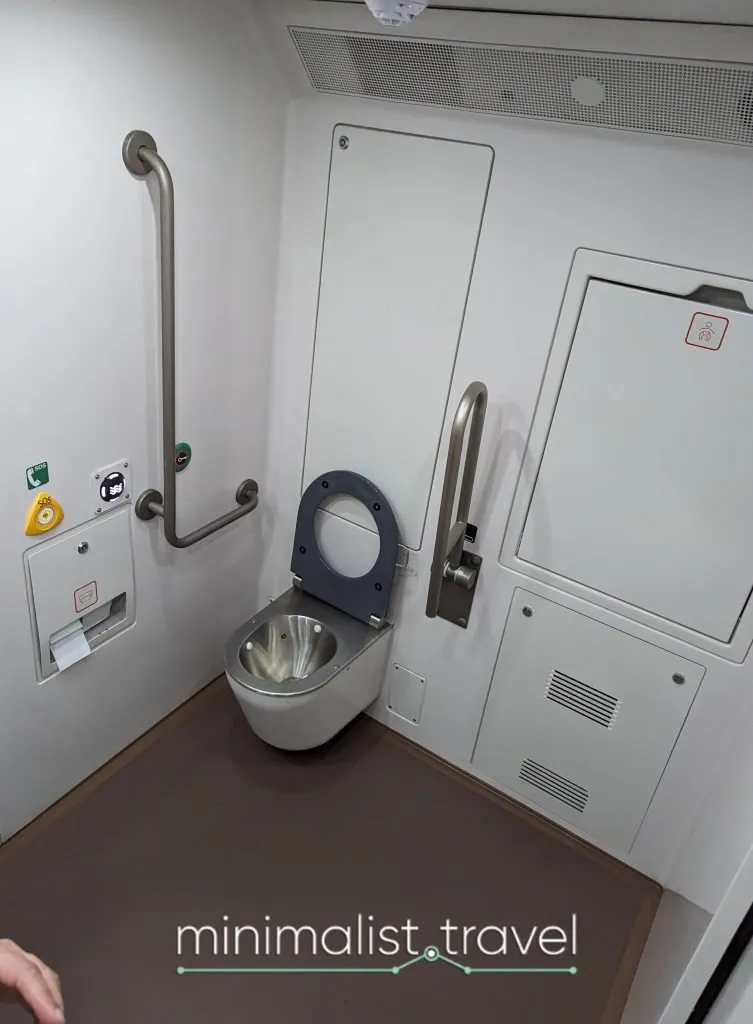
The restrooms seem to be well-cleaned and maintained in Iryo trains. They are located at the end of cars.

There are accessible restrooms that have a lot of extra space to maneuver around in.


WiFi
The Iryo internet WiFi service was intermittent and not very fast—the same as with WiFi on any high-speed train that we’ve taken in Europe. You can use Iryo WiFi to send a few messages, but it was not fast enough, for example, to smoothly play a YouTube video. The service cuts out entirely when the train goes under (frequent) tunnels.
For a nerdier take on Iryo as a company and its services, see our guide to what Iryo is and how to ride.
Iryo First Class (Infinita Bistró) vs Standard (Inicial) Class
I’ve tried out both the most expensive, fancy option on Iryo and the cheapest. There’s not that much difference (neither in price nor in features), but I’ll give you details here in any case.
Standard Iryo: Inicial and Singular Classes
Iryo Inicial is the basic, standard offer and covers most of an Iryo train. Seats are generally four-to-a-row in sets of pairs. I do not find this experience to be at all cramped—the standard class on Iryo is quite comfortable.

Iryo Singular offers the same four-to-a-row seating width as Iryo Inicial, but with the ability to take a large suitcase as well as your carry-on and hand baggage.
In Iryo Singular there is also slightly more flexibility and reduced pricing on any schedule changes you make after your purchase. Unless you know your schedule will likely change, it’s not worth it just for that perk.
In both Inicial and Singular classes there is no meal included, but there is a cart with beverages and snacks that comes around at least once. You can also head over to the bar in car 3, which is a nice break and walk in any case, and it’s fun to practice speaking Spanish and Catalan.
Iryo Singular Only YOU is a seating upgrade; you get slightly more space as the seats are three-to-a-row across the width of the train. There are pairs of two seats on one side of the aisle and single seats alone on the other side.


Iryo Infinita Bistró (the top class) is the same as Iryo Singular Only YOU in terms of seating—seats are three to a row. The main difference for Infinita Bistró is that a welcome drink and a meal are included.
In both Infinita Bistró and Singular Only YOU, you can take the same three luggage pieces as in Singular.

I got the salmon (“del Mar”) meal and it was a small piece of salmon—just a light snack really, and not, as I was hoping, an actual lunch. It was nice to be able to get extra water and coffee as I worked in this class without having to get up and walk to the bar, and these were included. The service staff seemed to come around more often in Infinita Bistró than in my experience with the other classes, perhaps because it is the first car on the train and located between the front and the bar car.
So if you’re thinking of upgrading to Infinita Bistró just for the meal, it’s probably not worth it. You can pick up a snack in Barcelona Sants, Madrid Atocha, or in or near other train stations—my go-to hearty and portable meal travel plan in any bar near a train station would be to ask for a sandwich with an egg and potato omelette: a “bocadillo de tortilla de patatas” (in Spanish) or an “entrepà de truita de patates” (in Catalan). You’ll be asked if you want tomato with that, and you should definitely say “sí”.
Which class in Iryo has less noise? Since there are fewer people in an Infinita Bistró or Singular Only YOU train car, you might expect more silence. There are also generally fewer families with children, though not always. It really just depends on who your neighbors happen to be. On my most recent trip in Infinita Bistró, American business people were talking very loudly, running an entire two-hour strategy meeting in the car it seemed. Great if you’re a corporate spy, but not so great if you want to sleep.
Another note: You can choose your seats, and those with the most leg room and room all around are seats 1A and 1D in the Infinita Bistró class.

I took this option, and it was too much leg room in fact for my purposes as the seat was too far away from the table that folded out of the seat in front of me. I needed to sit forward at the edge of the seat in order to type this review. This was not a major problem, however, and is not an issue with any other seats in Iryo’s first class.
At Madrid’s Atocha station, an Infinita Bistró ticket on Iryo also enabled me to skip to the front of the 5-10 minute line at the security check.

Iryo Trains Versus Flying
Iryo (and any other high-speed train option) is nearly always better than flying:
- The seats in Iryo trains are much more roomy and comfortable than airline seats.
- When you include the additional time for airport security and transportation to airports, high speed trains are generally faster in Spain compared to flying.
- Iryo and other high speed trains are quite competitive with flights in terms of pricing, though you may sometimes find cheaper budget flights.
- The carbon footprint of a high speed train like Iryo is 80% less than flying between for example Barcelona and Madrid.
I would myself only take a flight if going somewhere with poor or no train connections, like from Spain or Catalonia to Lisbon (though this is projected to be fixed with new high-speed connections, supposedly, in the coming years).
Verdict: Is Iryo for You?
Iryo is awesome: reliable, comfy, and fast. But the differences between it and Ouigo and Renfe Avlo / Ave are minor. I tend to go with whatever is cheapest and most convenient for my dates and destinations in a Trainline search.
I’m happy to hear your opinions in the comments and update this review if need be.